Monday, February 14, 2011

FarmLifeBegins in 1940

The farm had tenants living in the house, Lester Erckfritz and his wife, Bertha, and red-haired toddler Ginger. His brother, Frank,  with wife Cora, daughters, Bertie and Eleanor later moved in, too. And next a cousin, Artie, also lived in the house. Dad had divided the house for we would be driving out from Chicago on weekends. Our weekend visits were much like camping out. 
Eleanor, Bertie, MK, Elayne


Little 7 yr. old Eleanor was a pest most of the time. She had


nothing to do but hang around us, follow us, and we didn't 


know how to shake her presence. Bertie, our age,  was a 


companion to talk with and share. Artie was our age, too.

We kept warm with a brown, metal, oil heater with black pipes through the ceiling. We used a hot plate to prepare our meals. There were no electric outlets along the walls. Cora loved to bake so we frequently bought yummy desserts from her. We ate lots of Irish stew cooked in a Wearever aluminum pot on the electric hot-plate. I cannot conceive how these 2 families could live in so small a space-- but they did. Times were hard for them. Never heard loud arguing. Again these were survival days for many folk. 
Dry Sink with Pump


The families had the house kitchen, without running water but did have a dry sink with a cistern pump on the right side of it. I think this pumped rain water. We had pails to collect any liquids waste including  dish water. We called these slop pails and when full we carried the heavy pail about the distance of a short block to the hog pen and dumped it into their food troughs. Oink, oink, oink, grunt, grunt, grunt. They loved this stuff. There was a board path to the outhouse which all of us shared. I think the men frequently relieved themselves around the place. Yuk! 
Windmill beside Milk House


There was a windmill pumping water for household and stock. We would throw a lever found at one of the legs to control the wind. Days of little wind the men had a small gas engine turned on to do the pumping. The windmill was close by the house and  the small  Milk House was beside it which contained the large cement tank holding the cold water pumped by the windmill to cool quickly the milk cans filled with milk from the morning or evening milkings and awaiting pickup by a milk truck transport to the Borden milk plant in town.


I cannot recall whether these men hand milked the cows in the barn. I am not remembering milking machines.  
Early picture of the house w/o Bridal Wreath Bushes
Corner of horse barn in right rear view
Our father purchased 2 huge, dapple gray Belgian horses. They were kept side by side in their stalls in this large, gray horse barn. There was a hay manger front of each where we were to keep their hay. We also had to feed them oats from a bag we’d hang over their noses. You may have heard grandfather say he didn’t want animals around unless they were useful. We did put this pair to work, literally workhorses.


Our team was grey. The harnesses are correct


They had large and heavy harnesses which had to be slung over their mighty bodies, and don large collars. Today I wouldn’t have a clue how to put them on. Elayne and I did harness them up. After harnessing we would lead them from the barn and hitch them up to this horse drawn cultivator to work the garden soil. Several times a hoof would step upon my foot so I became very leery how to lead one. Wow, this could hurt! I cannot recall their names. What sticks in my memory is their huge size, their dapple gray coloring, thick hairy manes and tails.  I wonder now if dad didn’t get rid of them because they were so large and posed a danger for his children.  Anyway, we would do our cultivating chore, return them to the horse barn, unharness them, give them an oats reward. Where was the water? I do not recall. There was a cow tank across the yard near the cow yard. Jim writes:


 "The horses names were Teddy & Betty, a mother & son combo, who really didn't get enough workout, and hence were quite unruly. Pat Seaman eventually took them as he had lots more work for them on a daily basis - just what they needed to calm them."
My father used the team a great deal. He had this horse drawn shovel or scoop to which he often hitched them. With their help he changed the entire landscape of that yard, from the house to the barn. He’d dig and scoop, dig and scoop, for months until he had a beautifully landscaped yard. In our high school years there were times after a heavy rain, as I slept with my head into the window by my bed I ‘d become aware of strange sounds, heavy breathing, munching, coughs, footsteps and I‘d awaken realizing some cattle had broken through fencing. I’d proudly rouse the household. This was a very sensuous thing for me. The soil dad worked had not yet compacted. I’d drive the cattle out of the yard and onto the road having to take my steps, up and down and knee deep in slushy muddy yard. Was no fun the next day when we had to mend fence, wire stretchers and all that.  Eventually, we tore down the horse barn. We planted trees all about the property. Years later Dad would plant evergreens which grew to a forest and were broken into lovely homesites when the property was sold in the 70s. 
I am wearing the skirt I made in Home Ec Class
The long row of Bridal Wreath, one of our first upgrading tasks, was so beautiful each Spring. They grew shoulder high. We purchased another big bunch of them to plant along an expanse on the south of the yard at right angle to the gravel road out front.  I stretched out a guideline and proceeded to dig my holes and plant the shrubs. When dad came home, recall he was a gentleman farmer and daily took the train to Chicago, he was indeed surprised. The small shrubs were in a straight line all right, but they were lined up probably in a 110 degree angle from the road. We had to remove each and every one and correct to a right angle.  I thought I’d been especially helpful. This was an early learn a lesson time. Elayne could have been out there with me. I don't think so. She was usually the ‘boss’. I think the energy came from my own idea to do it myself.
Mask, work gloves, and hair in kerchief


The house originally had a front porch attached. Could be it was sagging. Daddy didn’t like it and we tore it off. Next project was to remove the leaded paint from the house siding with wire brushes. We wore masks so not to inhale harmful lead. When the wood was wire brushed we next painted with linseed oil and finally with white house paint. Behind the rock foundation beneath where the porch had stood we filled in with gravelly soil and atop that with flagstone. These years many houses were painted white and frequently had green shutters. We never added shutters. The barn would be painted white.


After we moved to Hebron permanently dad had a chicken business to take care of. Dad would take a crate/s of candled eggs into his workplace. He would sell the fresh eggs to an appreciative city folk clientele. Must have been enough profit to be worthwhile. We had our own recipes which would differ depending on which birds were being fed, pullets, hens, roosters, chicks. We mixed our own mash in our cement mixer, ground oats, wheat, barley, meat scraps, egg shells, etc. They loved it with a little water added to make it chunky. I must get the quantity right for immediate use though. If too large a quantity of water the grains could mold and sometimes did. .


Often we were challenged to put the chicken heads to the block and chop off a head. Did you ever succeed, Elayne? I never, ever could. They were pets to me.

Mother had her Easy washing machine and her electric mangle it is true. I want to share how laborious Monday washdays were. I explained this house had a cellar. Out of it came each weeks washed clothing. 
Copper Wash Tub


We had a large copper boiler to fill with pails of water from the pump and then heat up. Mother would let us know when she needed to refill the boiler. This water would be transferred to her Easy, along with soap powders and we would then wash whites. We would move whites to the centrifugal basket to spin out the water back into the wash tub to be reused for coloreds. Now one could run faucet water into the centrifugal basket for the rinse but in our beginning there was no faucet. We needed more pails of water. Cold rinse. 
Umbrella lines by Chicken Coop


Once the whites were taken care of we would toss them into a lined bushel basket and carry it up the cement cellar steps, throw open the doors above our heads, out to the clothes line and hang to dry. We would use the same water to wash the coloreds and follow a similar procedure, next on to the darks, overalls, work socks, etc. We would be constantly working at the machine. One can surely understand one of the early projects dad engaged in was digging out more cellar to include a cement floored basement. Some days the clothes froze on the line. Some rainy days we fussed with the laundry all day long and then some. Hung out laundry rewarded us with the delightful fresh air aroma.


Eventually, we had a laundry space with wash tubs and faucets with running water and adjacent to this the underground garage area to park our car. That original cellar door was removed, gone.  Then we would enter and exit with the wash basket through the garage door opening. We used that Easy Machine for years. Dad grew weary of fixing things, maintenance. Mother never had an automatic washer and dryer. By the time these were in most every home we kids were raised and gone. They took their  laundry weekly to a laundromat in Richmond. 
Later Enter/Exit Basement Through Garage

The rear of the house probably didn’t look like this until 1945 and even later. Double garage basement door swings open on hinges . Overhead is a concrete floored rear porch which leads on the right to rear and side yard and on left leads to farm buildings. The kitchen door is shown. Window on right is the dining room window. Side of dining room beneath where the tree casts a shadow is where the old cellar door and cement stairway once was. 

Sunday, February 13, 2011

Family Anecdotes Chicago Years '36-'41

My Auntie Maime


I add this picture of our Auntie Maime Morris, my grandfather's sister. Here she is in her prime. She had been a life long teacher in the Milwaukee Public Schools. Her hair was red, though not bright red, like Auntie Gladys Morris Dobeus. 


This comment below is from my all grown up little brother, Jim Bergin. It concerns her death as remembered by a 4 year old or 5  1/2 by my calculations.


Quite a "Looker" eh?
I can only remember being at her apartment (I guess it was) with the Collins
(from Chgo - the Morris cousins already resided in Milwaukee, so their
parents were able to come and go without their children)
cousins in the summer of 1940 I'm thinking, as my mother, her sisters 
brothers gathered to say their last good-byes while Auntie Maimie lay dying
of cancer I believe.  I had no idea she was so beautiful.  I was but 4+
years then and would have gone up to Milwaukee with my siblings from the
summer at the Hebron farm.
I was about to get this on its way, when it occurred to me that this was my
1st exposure to the concept of death.  We cousins were at times rather
crowded into the apt. confines while our parents were mourning and
comforting their very ill Aunt.  It was here as I recall that I learned such
sagacious verbalizations as "Want to fight??" Response: "Go join the Army!"
or, "Our Father who art in jail eating peanuts by the bale, Along came the
Holy Ghost, to see who in the Heck could eat the most!"  So there now, some
insight for you as to how one grows into such wise, loving, compassionate,
citizens of our world.  All of course quite innocent I should think for
confused, bored kids passing the time under such unusual circumstances.  By
way of disclaimer, I cite the above as the best of my recollections -
perhaps it's all in my dreams.
Our '36 Dodge no whitewalls, color grey


My own memory is of Elayne and I sitting out front of our Great Auntie’s  21st Street home in our car as she lay dying. Mother and Aunties were at her side. Mother came to the car and shared with us she was in excruciating pain. Was marijuana used or morphine or what else might have been administered to help her cope with pain? I do not recall that we were ever invited inside. Perhaps we chose this option. I believe I would need outside encouragement to be present at her deathbed.


Only one radio per household, of course


There were times our Uncle Michael [Mike] would ride the streetcar to visit us. His sister, our Great Auntie Maime now being deceased. She had been his caretaker for many years. He had suffered as a young man from polio. Now, in the 40’s Uncle Mike was living with the Collin's family, Chicago. He wasn't too welcome as far as we were concerned for he always hogged the radio to listen to Cubs and Socks games which times would eventually conflict with our kids show, Little Orphan Annie, Don Winslow. Tom Mix, Jack Armstrong, the All American Boy and Wheaties the Breakfast of Chanpions. Click here for a sample:
http://www.otr.net/?p=jarm


There were times our Uncle Michael [Mike] would ride the streetcar to visit us. His sister, our Great Auntie Maime now being deceased. She had been his caretaker for many years. He had suffered as a young man from polio. Now, in the 40’s Uncle Mike was living with the Collin's family, Chicago. He wasn't too welcome as far as we were concerned for he always hogged the radio to listen to Cubs and Socks games which times would eventually conflict with our kids show, Little Orphan Annie, Don Winslow. Tom Mix, Jack Armstrong, the All American Boy and Wheaties the Breakfast of Chanpions. Click here for a sample:

A favorite of mine was The Singing Lady

Irene Wicker, better known to her radio listening audiences of the 1930s and '40s as The Singing Lady, hosted a long-running kids show on network radio. Though not much is documented about her pioneering success, here a few lesser known tidbits about her and the show we'd thought you'd like to know:

1. The Kellogg Company sponsored "The Singing Lady," beginning in 1931. The show was billed as the nation's first radio network program for children.

2. In 1932, Kellogg hosted a promotion where listeners could send in cereal box tops for copies of The Singing Lady's Songbook. The contest was a runaway hit.

3. At the 1934 Chicago World's Fair, when famed crooner Mel Torme was about ten years old, he won the children's section of a singing contest which was judged by "The Singing Lady." Today, she is still credited with Torme's early success. When she began a new radio soap opera called "Song of the City," she remembered Torme and cast him in a singing and acting role, thus catapulting him to child stardom.

4. The show itself was always hosted by Wicker, who was known for her melodic and soothing voice. And while the show's title would lead the average listener to believe that songs were the program's predominant draw, Wicker actually devoted a large amount of airtime to storytelling.

5. Wicker adapted many classic and popular tales for her child audience--including the works of Oscar Wilde and Charles Dickens, as well as myths and mysteries.

6. In 1935, Kellogg published When the Great Were Small, an educational book intended to inspire children to the pursue the greatness of the artists and musicians who were their predecessors....

7. For her devoted work in children's media, Irene Wicker was awarded a Peabody Award, a distinction for outstanding achievement in radio and television. in 1960.


Easy Spin Washer


With his new employment Daddy was providing nice things for mother.  So nice to have a few modern conveniences to assist women with housework. We bought an Easy Spin Washer. [In 1951 I had my own Easy, a first purchase after Bruce and I married.]
A Modern Mangle


We bought an electric Mangle for ironing our clothing and mother became quite proficient in its use even ironing dad's dress shirts. Along came Permanent Press and nylon and dacron cotton, fibers which wouldn't require ironing making it gradually almost obsolete.


Another convenience we bought was a Kenmore Cabinet Electric sewing machine.
Change in its use came about with imported clothing that was inexpensive, stylish, so that no longer was sewing one's own a big advantage over store purchases, unless one had designer talent. Now used mainly for mending and crafts such as quilting, etc.


There were times we visited old friends, the Blaineys in Glen Ellyn. The parents were friends from University years. We were longtime friends with their children. See this early snapshot. 
RuthMarie and  Lois Blaney
Friendships with classmates, and others were maintained. My parents would occasionally go out for the night or take a weekend for a Marquette Homecoming. One of these weekends when a few of us were dawdling about or playing in the backyard a guy from school hung a 1/3 full white paint pail on a branch of a deciduous bush growing beside the neighbors garage. Somehow the branch was twitched and the paint splat out on my head all over my hair. Our caregiver had some explaining to do.


I usually was involved in the preparations for the evening out for mother would need a new dress. I ‘d be there to help her make her decision. The Morris/Kirbys and especially grandmother was a shopper and a dresser. This wiped off on my mother. And my Aunt Florence, too, had a flare for clothes. Even when the family had little of this world’s goods Auntie Florence would sew so the girls could wear nice, stylish clothes. I enjoyed shopping with mother. She often bought her clothes at some small dress shop. She loved pretty hats. A number of times she would have a matching dress and hat made up special for her. Recall grandmother Morris, Kathryn Kirby Morris, had worked in millenary after arriving in Minnesota from her home in Bruff, Ireland. Or mother would have something old of her own remade so to be stylish. She did this with her black Persian Lamb fur. One time she had an overcoat of my dad’s remade as a winter coat for my sister. She even did this with our monks cloth drapery. 


Sears Catalog was frequently in use. Our parents would choose clothing items, order by phone and have them delivered. Christmas was quite different now. One year mother ordered many pieces of clothing from Penney’s, had them delivered and wrapped without our being aware. And then there was a time she was able to land a sales job at Marshall Field’s for the Christmas season. She used her earnings to restock our linen closet, sheets, towels, washcloths, tablecloths, the whole nine yards. These purchases would last us a long, long time thereafter. 
Grandmother and Granddad Morris Visit in Chicago

Our Grandparents visited us a few times. Grandad would just take off and drive down from Milwaukee.  The woman , rear, could be Auntie Maime. I remember the Aunties chiding him for driving. Was this a concern for his heart? They didn’t want any accident. Then he died of a heart attack September  30, 1938., less than 2 years after we left Milwaukee.  
We continued to visit Grandmother occasionally in her home on Highland, Milwaukee and other family members, too.  She often said after Granddad died that she would have conversations with her John in their bedroom. Which to me meant he would appear, though dead.


Map of Downtown Milwaukee, Wisconsin


Downtown Milwaukee
Downtown Neighborhood showing all the familiar streets where grew to 8 years and visited often

This map available for your use


  I don’t know what year it was when the adjacent 12th and Highland corner  home was torn down and leased out to a filling station. And today won't do you any good at all to drive over to 12th and Highland. The corner no longer exists. It has been absorbed into an interstate Highway 43. One can follow where the old neighborhood was by locating Marquette, U. Wisconsin Avenue, 12th street, Highland, Juneau all in a mesh of freeways. It is a downtown neighborhood. Lake Michigan is on the right. 
Mary, Douglas, Baby Karen, Alice, and Barbara Morris
     My Morris cousins  lived  in the flat above Grandmother. Same home I lived in when I was in 1st Grade. They are all here now and a sweet childhood portrait. Mary, on left my favorite. Don't think she knew.
12 years old and my Surprise Birthday Party- October 1939
Shirley was growing up along with me
Mother and Elayne planned to have a special birthday party for me. They made artsy favors, planned a nice menu and invited my classmates from Our Lady of Lourdes, plus special neighbors. All this was done without my having one iota of awareness. Seems impossible their project could have been so well hidden. Wouldn’t a party be something very special for an 11 year old turning 12? 
To distract me I was told that mother and I would have a very special date when I returned from school in the afternoon on October 2nd. Plan was she and I would attend a Shirley Temple movie. They got that right. Shirley was growing up along with me. There was possibly nothing in this whole wide world I would have wanted on my birthday more than this.  


When I walked through the front door in excited anticipation I was greeted with a chorus of voices singing out “Happy Birthday” from the living room filled with friends. I was surprised all right and at the same time I was disappointed. Now this would require a true escape to Raggedy Ann and the smile stitched on her face. I needed to hide my feelings pronto. Did I? There would be no Shirley Temple film though it’s possible we saw it later that month. We set about enjoying the party, the food, the games, the decor. Then that time arrived to open birthday presents. The interesting comment I have about the gift openings is that at least every other package opened was a pair of nylons. Nylons had taken the country by storm. I could cast off the rayon stockings. I was becoming a woman. I share this piece of research I found: "Nylons," as they were soon called, eventually replaced silk stockings [rayon for girls my age or worse cotton]. Neither resembled the "panty hose" many women wear today. Covering only about two-thirds of a woman’s leg, from the feet to mid-thigh, stockings were fastened with garters and a belt. They were knitted on highly complex machines. Women could buy them in either "full-fashioned" form with seams at the back or "seamless." 
I was soon to discover those seams were just about impossible for a 12 year old to keep straight, especially one who skips and runs and dances everywhere she goes. Good thing we always changed into our play clothes after school. 

Sunday, February 6, 2011

Boston??? -Decision '39-'40

There was a time while living in Chicago when our family might have moved to Boston, Massachusetts.  I have no idea whether it was a job transfer or a new opportunity. The subject was broached when all of us were together. Our parents discussed this for some time as a possible venture. Eventually a decision apparently made not to leave Chicago. How different all our lives would have been had we made another choice and moved northeast once again. 


After this very important decision was made another seed of an idea seem planted within our family. My father took extremely good care of the 2 flat we lived in as renters. The next door neighbors, the Hickeys, Especially the senior Hickeys were encouraging my parents to get a place of their own. Daddy's  job seemed secure. Economy was picking up. England and Germany were at war. Terrible things were happening over there. Some families had sons in military service. We would know this for a star was exhibited in front windows of these homes. I remember listening to the news on the radio in our living room the day Germany moved into Poland. This news was so frightening.


There were popular books being marketed. One my parents read was  Five Acres and Independence A Practical Guide to the Selection and Management of a Small Farm, which would give support for daddy to ‘give such a venture a try’.  Even some films were produced which probably encouraged daddy in his pursuits. He was bit with that bug. We have a paperback copy of 5 Acres on a shelf. Apparently Gran read it, also. [Beth Fellows Stewart, that is]


Eventually he would  take short drives out west of Chicago into the farmland. Perhaps weekly, he’d take turns with one of us children as companions, a date with daddy, looking for a small piece of farm land.  We loved our date with dad and exploring some exciting prospects.
Big White Letters Sunnybrook Farm


I recall on one excursion I accompanied him when he was seriously considering a particular farm. As I awaited in the car I read the words Sunnybrook Farm painted in large white letters on the front of a big red barn which seemed so romantic to me.


I had read the storybook, Rebecca of Sunnybrook Farm by Kate Douglas Wiggin. This, however,  was not the one we chose.
Hebron, IL  intersection 47 and 123


Eventually, the land he found was in the township, Hebron, IL. This was not at all a small piece of land but a full fledged farm. This was more than a house on an acre. There were many farm buildings, and on 180 Acres of land, not 5 A. and much more investment than anticipated. Besides the farm house on this farm were a fading red cow barn, a milk house,  a pig pen, chicken coop, hen house, a corn crib, a granary and a large gray-black wooden 2-story horse barn. We were about to put flesh on his dream even though it would truly stretch his/our resources to succeed with something so large. Each of us would soon give our own meaning to the word independence. 

Acquiring this farm and determined to make a go of it we lost focus, attachment, relationship with the Bergin family in Fond du lac, WI. and the Morris family as well. Now we children could and would spend years of our lives on this farm of our very own near the State Line in Illinois. What we imagined were the vacation days at granddad Bergin’s farm in Fond Du lac, WI. This could only seem like a very exciting venture to us. Daddy made clear to each this was to be a family undertaking and any success would depend on each one of us. The reality of permanent farm life would paint a differing picture in the days ahead than the one we had of Granddad’s Farm. Daddy now saw farm ownership as something he would be able to accomplish. [with help from wife and kids]. As a matter of fact it could not have been successful without each one's input.

From the moment the decision was made on the property, while living yet in Chicago, I would see my daddy when home after his workday seated at the mahogany dining table. He would take out his drawing board and work on his plans for the house on this property using his engineering knowledge, things like a  basement, roof line, additions, landscape, etc.

Not directly related to this decision I want to include this in my tale. Throughout the 4 years we lived at this Greenview, Chicago address my father would invariably announce as he prepared to leave the house for his daily work, “I am off to college”. I do believe this statement was an important message from my parents that this is what we were to do, too. We saw it as an expectation. Education was valued highly and was to be continual.We were to continue our education beyond high school and into college. This was an expectation my father held and verbalized, and for that matter on-going as long as we lived. And so it has been for me, as there is ever something to know, to learn. Death is when I cease learning. 


Greyhound Trip To The Farm '39

1939 11 years old
Greyhound Trip to Fond du lac
The family planned this trip, a summer vacation in 1939 for the 3 of us, Elayne, Bill, and myself to visit the farm in Fond du lac, WI. We packed up what we would need for the vacation. When the day arrived we boarded the Greyhound bus in uptown Chicago. Before the bus pulled away from the station Mother gave the driver some basic instructions and we were seated in the seat across the aisle so he could keep an eye on us. We arrived in Fond Du Lac safely, were met by family, probably a young uncle, and brought out to the farm.
Movie Classic 1939


I remember waiting beside the movie theater which was showing the WIZARD OF OZ. We were promised that we would get to see the movie. Usually once at the farm we would just remain there except for Sunday Mass at St. Patrick’s or St. Joseph’s. You have seen little girls with long braided hair which becomes wispy in just one day, especially overnight. Well, come Sunday mine must have been something, because grandmother finally prevailed upon one of the young uncles, Tim or Mansfield, who knew how to braid rope they said, to braid my head of hair. I was so embarrassed at Mass as my hair was like 2 ropes hanging on my head. [Perhaps like a Pippi Longstockings]. Probably was a big improvement from grown ups point of view. 

I remember one or more Sundays after Mass visiting Aunt Marion at the Children’s Home. She perhaps worked there as a nurse. This fascinated me. 
A House Very Similar to Homestead


We 3 children spent many idle hours on the front wood porch, with only the view of trees, grass and sky before us. There were fowl, chickens, geese, who by mid-day would wander up from the farm buildings. Occasionally they would come onto the gray porch floorboards and leave their moist droppings. I think the hens were mixed colors or breeds. We could enter the grandparents’ living room via the door on the porch left. Once indoors I remember seeing a rocking chair. [cousin Dorothy has this treasure], and then a table to my right which held photograph books,  the family bible, etc.


There was a table on the left side of the room on which was set a radio with a large horn  on it. Not the dog, of course. 


Across the room from this radio was a large doorway opening into the dining area with its big claw legged oak table and oak high back chairs, leather seats. We ate many breakfasts at this table and many an ear of corn and warm milk poured out of green glass Mason canning jars. We must have been there some times late in the year. I remember playing cards in the twilight with granddad, sister and brother at this table, particularly a game called “old Shanty”. He’d have this oil lantern to cast light on the table. Smell the oil?  I dearly loved the sound of his voice and his dear snow white handlebar mustache, sparkling eyes. When I met with cousin Jack Bergin in Boise while RV-ing in the nineties I thought Jack's voice and appearance were much like my memory of granddad. I loved all the voices of the young uncles. Their voices were  similar with such rich tone.


A Painting Catches It All


Grandmother was most always working around the kitchen at the big, black cook stove keeping the fire going and heating water for personal hygiene. At mealtime her sons would arrive through the rear door onto a kind of mud room, wash up at the basin set on a stool before entering the kitchen and seating themselves at the dining table. The smell of the wood burning, the warmth, the breakfast smells are vivid to me. Most of my memories are seeing her working about the kitchen area. She must keep the wood burning in her stove for heating water, for baking, cooking. This was a large family they were raising. My father would refer to his mother with such love. I now know it is her constant being there and giving so much of herself that he treasured. 


I found this verse by Karen Ray on Google which captures, I think, some of the nostalgia my father might have had concerning the stove, that kitchen, and his mother. She shares.


Mama’s old wood cook stove--                                           
I remember it yet, All the goodies Momma cooked,
how can we forget?
For her to fix meals was always a pleasure,
My memories of Mother are always a treasure.
That old stove cooked three meals a day,
Light bread on Fridays, cakes and pies for holidays.
Cooked hams, turkeys and chickens with delight;
Many times used for canning until late at night.
The old stove heated the kitchen on cold winter days.


It served us so well in so many ways.
When we kids got home from school,
We always went looking
Straight to that old stove to see what was cooking.
An old iron pot that cooked the meat
Sat on the old stove, always cooking a treat.
Aroma of corn bread from the oven you’d smell
For us hungry kids, it sure cast a spell.
As my mind takes me back to the Good Old Days,
Our lives were so simple in so many ways,
But picture my mother in an apron if you could,
Standing by her cook stove with a bin full of wood. 
Karen Ray-  shares


Nearby was the slanting cellar door leading into the black, earth floored cellar. It was cool down there but not cold and this is where grandmother kept the milk for us. Seemed always to be warm and creamy, coating our lips, very different from the pasteurized milk from the bottles delivered at our house by the milkman. Kind of hard to drink, truly. When my mother often sang, ‘I don’t Want to Play in Your Yard---’, I always visualized this cellar door and grandmother descending the stairs to bring up the milk in her long, cotton house dress with her yellow gray hair piled in a bun atop her head. Times she’d ask us to fetch the milk from the cellar.

We slept in an upstairs bedroom. There were these very different windows which were almost down to the flooring. She kept a chamber pot in the room which we were to use during the night. It could smell quite hefty by morning, most mornings.
Old Shep

I believe Old Shep, their beautiful collie, was always grateful for our visits. He accompanied us most everywhere we went. He grew old through these years along with us.


We played fewer hours behind the house than out on the front porch. Here we would see the long grass deep green color of the grass and the yard sloping slowly down towards a creek bed with a shallow stream of water running through it., Van Dyne Creek. We were told that it was on the hill rising up from the opposite side of the creek that our grandfather’s uncle had built his home. My grandfather’s 2 older brothers had moved on West to Minnesota. We always were intrigued with such romantic historical information and thought we could spot the place where the house once stood each year as we reminisced when revisiting.  


There were large trees near the creek and often a farm implement was resting there. These were horse drawn and had the perforated metal buttocks formed seats and brakes and clutches which were a joy for us to play on. Uncles treated us kids royally.


We got to sit on the tractor with them, smell the gas vapors puffing out the engine. A few times we were taken out in the fields with that smell of the earth being turned. What a treat. The house was some distance from the red barn. 


We’d come first to the windmill with its pump and tin cup dangling there inviting us to pump and have a very cold drink of water. There'd be a metallic taste, either from the tin cup or the minerals in the well water or both. At any rate this was quite different from city tap water. Made the most lovely grinding, squeaky sounds as we pumped away and water splashed onto the form on which the pump stood. 


The machine shed stood in front of us and to our left. Here we often hunted eggs laid on implement seats, and hidden away in corners, most anywhere.


Can still hear the hens proudly cackling. We’d surprise one and she would jump up and flap her wings all in a flurry. There were usually baby kittens about for us to discover and to play with. A cow barn to the right of the pump held the good smells of fresh hay.

We were allowed to play in the hay or in the yellow straw. I wonder if perhaps we weren’t supposed to but the young uncles tolerated the play. We figured we were the only kids in the world to have this experience, only kids in our Chicago neighborhood for sure.


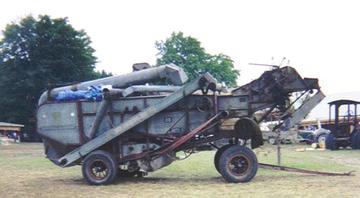
Times when we visited the family would be threshing the grain or recently finished, there being much hustle and bustle on and around the huge threshing machine and many wagons.. There would be a huge stack of golden straw mounded high beside the red barn. Times like this those hens seem to love laying their eggs in the fresh straw.
Threshing Done For Another Year
I learned the threshing machine was invented in 1784 by a Scottish mechanical engineer, Andrew Meikle, for use in agriculture to separate out the grains which for eons previously had to be separated by hand with flails. This was a huge improvement.


There was one Sunday morning, bright and sunny, the fields were all shiny, golden stubble after the grain had been harvested by a threshing crew. I was standing in the lane as I saw granddad walking up the long lane from the road to the house. He was a bit tipsy. Didn’t seem to recognize me. He was a changed granddad, without his cheery words. Been out all night. This was the first I learned he had an alcohol problem.