Tuesday, March 8, 2011

Tullybrackey 2 Takes Shape

My mother and dad named our farm in future years Tullybrackey after my grandmother's country home [Kirby estate] in Ireland.
Family Home on the Kirby Estate Bruff, County Limerick, Ireland with Vines in Fall Color

At one time there was a cellar door on the south side of our home, approximately beneath the living room window. One summer afternoon the sky was darkening and the air was mighty still with a ghastly silence [birds know, I think]. A storm was brewing. We would soon learn these were signs of a tornado.
Cellar doors

Dad hadn’t arrived home yet but the 5 of us opened the slanting cellar doors and retreated in safety into the earthen basement, closing those doors above us. The storm soon arrived and raged overhead. We heard many loud and frightening sounds.


Silo fell collapsing the new Milk House

After the storm passed followed by a period of stillness, all above seeming OK,  we dared to emerge from our place of safety. Beside our barn stood 2 twin wood stave silos like the one in the picture. They were there when we sought safety in the cellar. Looking around the yard we discovered both wooden silos lay down flat on the ground. We had heard the frightening sound when they dropped, we thought. Many times after that,  whenever we saw a storm approaching from the west, down into that cellar we would go. We learned to watch the sky for weather. Nothing like this ever happened again. Those silos were never  raised. 


Barn before being painted day of the cyclone


Between the fallen silos to clean up,  the red cow barn needing paint, eventually tearing down the horse barn, pulling nails from the boards, along with our gardening chores,  learning to can and freeze foods, mowing lawn, our chicken care, later our calves, our sheep, watering trees, working the land for crops my dad had provided enough work for his children to keep them occupied daily right on through high school years. We often heard the words ‘an idle mind is a devil’s work-shop’ and I took it to heart. I recall the only time when no chore was hanging over my head was the annual Triore [3 hours] radio program from Gesu Church, Milwaukee on Good Fridays.  We were totally free to relax, sit back with the radio station  tuned in and participate in the liturgy. On one particular Good Friday I recall  as soon as the hours were over I had to head for the wood pile and ’get to work’. Constantly demanding chores. Doesn’t mean I didn’t go at them like a kid. I did. I can see my father's face as he frequently reprimanded me.

There was this train station, Milwaukee Road, out in nowhere [Hebron Siding] where dad would flag down the  train to Chicago, climb aboard and onto his job at American Printing Ink Co. After a bit of time the siding stop was abandoned. Dad then caught the Chicago Northwestern from Richmond 7 miles away into Chicago. Dad was successful in obtaining what we called, ‘the Tower’ at the siding. Since it was abandoned he had it moved to a piece of land just north of our red barn . He dug out and then poured a concrete basement for the building, with our help, of course. There was always lumber work to do but no electric saw. If you were to drive past some day you will see the old Tower building, kept up and being useful to the present owner. At one point we used this for the rooster house. There were plans to one day turn the building into a cottage.


Daddy would require one of us, taking turns, to go to work on a job with him so we could ‘fetch the nails’ or ‘hold this board’, 'shovel in gravel and cement into the mixer'. Sometimes the entire family sat around watching, visiting, especially on Saturday mornings.  On days such as that I would get out of some hanging around time  by volunteering to go to the house and get lunch ready. Elayne will tell you I got very good at making great white sauce, one of the first things we learned in Home Ec, Senn High,  to be used in many, many dishes. Times like that I was a real crowd pleaser. Later mother encouraged me to major in Home Ec in College as she saw this as an aptitude rather than my escape. I know now my major should have been social science. All alone we learned to pour some of the walkways with a good mix of rich cement up to and a bit around the house.  When the red barn was painted white Elayne and I did it after school. Dad would move over the extension ladder each evening and tie it down safely so we could paint 6 more boards. 6 by 6 by 6 by 6 until completed. I am quite sure he did his painting bit, too. We were ‘the club’ always and everyone did pitch in.
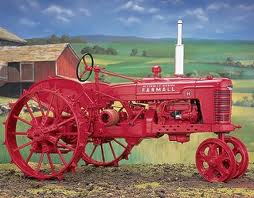

We needed to plant crops after the renting families left. Daddy purchased a Farmall-H,  a small farm tractor. It had big lug wheels. It took 2 of us to start the tractor for we needed to turn a crank up front and diddle with the gas feed to the choke on the side. Time and again we would flood the line and have to wait a while to try cranking some more. Exasperating.
Jim adds: Quite a photo of the steel-wheeled Farmall, except our's didn't even have fenders.  I remember arriving home from school one Oct. afternoon only to be amazed at this glistening RED machine parked just west of the old milk house.
One Sat. I literally walked behind Dad plowing with it in the 40 acre piece in front of the house; but at the time he was plowing quite near the boundary with Seamans. I just couldn't resist watching it turn that earth over and hearing its engine at full throttle - everyone thought I'd be exhausted after doing so for several hours until lunchtime came, and Dad came in. It sure was Red, and steel lugs because rubber couldn't be had owing to the WWII rationing. We weren't to get rubber tires until 1946 as I recall, and a battery, starter, & lights.  Only then did we find out to our dismay that it didn't even have the 5th (road-gear as they called it) installed at the factory in anticipation of eventually having rubber tires. We had to have it installed later even after the rubber tires.        
Just connected my thoughts with those later years starting the gas lawn mower. Finally, we would succeed. We hitched the plow to it sometimes. We would try our best to turn over a straight row of earth with the plow. Cultivating and dragging the earth were much easier operations for us. Elayne was quite successful. After the ground was well prepared we would plant the seed, oats, wheat, corn, soy beans. Dad did most of it yet he was grateful for any amount of acreage we could cope with. It all added up. When crops matured we would get involved in harvest-- mowing, raking, stacking or filling the granary bins with oats and wheat.


Reminds me of a small grove of mature and dying trees which stood at the curve in the road. We worked on those, also. Sawing and hatcheting were required. I recall an injury I sustained when I struck my right knee with the hatchet blade. Odd that memory returns. And then there was a mature hedge of lilacs up the hill from these trees which grew alongside a house foundation. Lilacs were easy to transplant. We transplanted starters around our farmyard. In later years we would plant an entire hedge around a home in Orland Park, suburban Chicago.
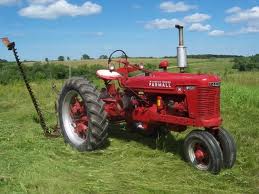
This is our Farmall on Rubber


One summer we ordered a tennis net for fun on the side yard. Balls didn’t bounce so well on the sod and we grew discouraged. Kept the net, the balls, and the rackets for years. Summer evenings we would ride bicycles up and down our road. Wonderfully welcoming were the changing cool temperatures up or down hill after a muggy day. The property was very gently rolling-- like a gently rolling golf course. Below see cousins growing up.
Front-MaryAnn, Alice, Bill, Mary
2nd row-Barbara, Judy, Florence
3rd row- Karen, Jim, Tom, Doug, Jack

Howie, Florence, Jim, Ceil
One summer when the cousins were young we held a reunion weekend at Tullybracky. I have no remembrance where each slept or what we ate. Wasn’t my responsibility, you understand. I know we pitched in and nothing was catered.


A calf dealer would routinely make his rounds among the farms in his small calf truck to buy calves any farmer didn’t want, bull calves or surplus heifer calves, to take to market. Daddy made a deal with him that when the dealer came across an exceptionally good animal he would save it from slaughter and sell to my father. Jim tells me: It became standard occurrence to have local farmers call with news of a nice heifer calf they'd like to see grow up to a nice cow rather than face slaughter by selling to the calf-buyers. This is the way dad built up a very nice herd of high grade cattle. We must feed and water the calves. When they matured we had their calves to feed. Milking became a project.  I was in college most of this time.


Jim and his prize 4-H calf


Jim shares about his calf: It was a bull calf sold to us by Lizzie Burgett for just the purpose of inbreeding our grades with a registered bull as time went along.  I don't (not sure) remember the exact name of the organization of Holstein Breeders. "We by then, had so many grade heifers it wasn't feasible to attempt replacing them with purebreds. So the bull matured, became very large and was used to sire; but eventually even he was considered too large - perhaps dangerous, so was sent to slaughter at some point. He was registered but that was it."


 "I still have that plaque somewhere in our holdings - 1948 as I recall. Shortly thereafter we simply had to acquire electric milking machines as we were really getting labored doing 13 of them by hand twice a day. It was quite an occasion to snap on the vacuum pump and commence hanging those Surge Milkers on our darling pets - we had names for each and everyone of them." We bought a cream separator also and had whipped cream at all our meals.

"In my memories it will always start with the Feast of Immaculate Conception, 1944, when upon ascending the hill to our driveway on way home from school, amidst the 1st snowfall of that season, there appeared to all of us a mysterious black ball on the snow, among the 3 Heinz 57 Guernseys huddled in what was the tile drain access hole, [in that 40 acre field in front of the homestead.] This little black bull calf became MIDNITE, the 1st of some eventual 50 to 60 head of cattle raised by us over the next 9 years."


At one point in time we had 2 sheep. They were so sweet though at times ‘Ramer’ could get mighty uppety and want to attack, that is, to butt us with the horns on his head. I would wonder why he would become so cranky. Was it jealousy or protecting his mate?
Nice picture of Elayne snapping beans or chucking peas
A woman on a farm up the road, Mrs. Burgett, had visitors this certain week. She and mother arranged for me to walk over and assist her with the kitchen chores. When the job was completed she paid me off in fertile duck eggs. I found a clucking hen to sit on the eggs for hatching. S’pose to hatch in a fortnight. Maybe I didn’t keep track. Time came when I grew impatient and seeing duckling was about to leave its shell I began to pick it open. I learned to let nature do her job for this duckling was now dead due to my interference. Lesson- 'patience is a virtue'.
MaryKay and dad


I have this nice picture of my daddy and me. I loved him very much. This is a very early photo I see. The house hasn't been brushed and painted. I can see the cellar door [later closed up] and a tiny fir tree by the front window. I think I see a tiny American elm about 3' tall to my right. So much yet to be done. Because my hair was so thick and long enough I braided the front sections, crossing each atop my head and pinning down with bobby pins, a bit like a crown and very comfortable. I used a 'pro-curler' for many years to curl hair with bobby pins. I have it in my drawer today.

Mother, Jimmy and Billy on a cold morning. See long bridal wreath hedge in the rear.
Off in the distance is neighbor Pat Barrett's farm. He played 'Uncle Ezra' for years on WLS


.


Friday, March 4, 2011

A Place to Grow


Me at side of Horse Barn


What I found was another dimension to my understanding who God is. Each one of us were  to learn  many' how-to-s' which city life could never , ever have taught us. We had this opportunity to know God’s earth in so many special ways. I would be introduced to life all around me and through my lifetime build an appreciation onto this basis . I loved the wind, the rising and setting sun, walking back to the house on moonlit nights, the smells, the seasonal cycles, the animals both tame and wild, birds, too, the pheasants. I had little problem accepting earth as part of God's Kingdom. We are in the heavens. * We were so private I could run and dance and frolic everywhere and I did-- the air, the breeze, the wind, the rain, the snow. So much so that at 15 yrs. or so my father, and more than once, wondered aloud to me if so much enthusiasm was ladylike. Times I felt in heaven.

I had a Saturday evening routine for many years. I would lose myself in my private rendezvous in the little office dad had built beneath the front stairway. I'd listen to radio's, Manhattan Merry-Go-Round with nice selections from New York. Following this would be The Hit Parade always cluing me in on the top 10 popular songs for the current week. With repetitive listening I would come to know the words to the melodies. Next would be Chicago Theater of the Air with dramatized Operettas with the likes of Jeanette McDonald and Nelson Eddy. No one in my family ever seemed to interfere with my Saturday nights. I could sing and dance about in a carefree, delightful piece of quality time. And I could sing these songs in my hen house, too. Often during this interlude my parents would get into their Dodge and drive out onto the grassy fields and hills of the property, all to themselves and revel in nature and privately share companionship. 


This property in addition to its rolling landscape had a creek, fed by a spring, crisp cool water bubbling out of the earth. It was about a couple blocks distant. At one time cattle had grazed here and come for drinks of spring water making the earth boggy. I must step from one bog to another to approach the stream otherwise my feet missing I would step into the squishy earth, wet, muddy. In the spring I could find these bright yellow cowbells appearing from the green, green grass. And this is the delightful spot where mother attempted to share with me her talk about 'the birds and the bees'. We had hours on end of privacy. I could walk to a far corner of the property or lose myself each night in the chicken house with all my feathered friends whom I recognized as individuals and gave each a name. I would sing my songs to them. They would lay the eggs for daddy to carry on the train into town to sell to co-workers. 

On bad days at school I would retreat to the barn hay loft floor with my Airedale dog, Duke, who would sympathize with my melancholy.  I could cry my eyes out, sob, perhaps even verbalize stuff and he'd just look up at me with his big, brown eyes and I would feel he cared and he heard me. I would never again have such an outlet for expressing my feelings. I would be  shelling corn off the cobs with my circling hands for feeding the kernels to my hens. I could linger a long time. How I loved that dog and he me. My daddy would often say, "This dog was good for nothing. We ought not have an animal around who is not working". The cats, you understand, were mouse catchers. Probably Duke was also. Had he ever thought of that?  Duke was working all right. He offered me friendship not found anywhere else. 

Duke

Animals taught us life and death, love and friendship as well as solace, how we depend on each other. Earth can be good and easy or tough and withholding, rain a gift or a trial. I loved God’s world from my vantage point. All this had to be the best. Additionally, I have a hunch I was at a good age to pick up on all of this. Maria Montesorri calls these ‘sensitive periods’. And my dad saw this appreciation as did my mother. And it was good, baby and it was gosh darn good. I now know this was the face of God. I was developing my sense of what life is all about. Those years God was mostly inside the Church for me or looking down through the clouds to see if He [male] might catch me doing wrong.   Where were the friends we left behind? We had close friendships. Coming from elsewhere Hebron, true of many small towns. was not so easy for outsiders to break into. And to top ordinary we were a Catholic family in a religiously very prejudiced Protestant Community. How does one make close friends of strangers? We each now had no time to nurture friendships, to finally engage with others as teens do. Life for us was different. We weren’t city kids now but we weren’t farm kids either. Daddy discouraged outside friendships because he needed us so desperately to be home working the project. He would actually say we don't need them. Maybe we did. A family, even one that works and plays and prays together is not all there is to life. He thought we would get all we needed in college.
We each had an experience attending a one room schoolhouse, the Burgett School, about 2 miles further on down this same road. There were no school buses. We walked or road bicycles. We had come out from Chicago for 2 years before the city schools dismissed for the summer and enrolled in this tiny country school for the couple of weeks remaining.I treasure this opportunity. Elayne was 8th grade and I 7th grade, Billy in 6th.  Jimmy in 1st would attend the following year. Mrs. Reynolds was the teacher. There was an oil space heater to warm the classroom, children all ages and grades. We could listen in on another’s lesson or be distracted. We were used to classrooms with 60 or more students in one grade. Recesses and lunch hour were out on the green grass with the smells of earth.
MaryKay and Elayne at Burgett School
A drink of water was available with a few strokes of the pump arm out in the schoolyard. There was at least one time of rural surrounding community get-togethers where we baked cakes or pies to share and included barn dancing, my introduction to such. I loved these few times. Mentioning cakes, I brought one which I had mixed in our Hamilton Beach mixer. I received so many compliments about its texture. Our Hamilton Beach electric mixer had been another of those work saving appliances dad had purchased for mother. Without one, to mix a cake,  meant creaming  the shortening until light and fluffy with a mixing spoon, add the sugar and continue creaming, the eggs, more mixing the sugar, the flour, the flavoring and then beat it all 1oo times. And maybe have nice texture.  Pillsbury Cake Mix was years away. The other ‘real’ farmers seemed to know all the dances. My daddy didn’t- was a gentleman farmer, part time, weekender, after hours.

I must share about my little brother, Jimmy. He puzzled me because it seemed all the thoughts in his head he would express out loud, verbally. Most my thoughts I had learned to keep inside my head and heart. Except there were the many times he would be my companion as we walked out into the fields or down the road and I would spiel out all that was on my mind or in my heart, problems, hurts, expectations, whatever. He would be my listening ear. I don't even believe now he much understood my talk. But he was there. He was with me. He was my brother. Together, I shared. Because he knew the words he was better than Duke. 
St. Joseph's Catholic Church, Richmond, IL

Our Catholic Community was 7 miles distant, St. Joseph’s in Richmond.  Only transportation was to ride together once a week in the family car. This was a small, white  framed little church much like the one room schoolhouse. The Pastor was a handsome, young Irishman, Fr. Blake. He was well liked and popular with the summer crowd. This church was handy for weekenders vacationing out of Chicago at the lakes to fulfill their Sunday obligation. On peak summer Sundays traffic was bumper to bumper all the way back into Chicago. Mother made friends  easily so our family was soon on easy speaking terms with most parishioners as well as Father Blake. There were community members tried, true, dependable who made the parish wheels turn. Priest did little in the way of catechetical education. Remember the organist, Molly Miller, willing though not extremely talented, played that organ and sang all the Latin for High Masses. or Requiem. There was a small attached room side of the church. Many years later a school was built on this sight, behind a new brick church.

One day the priest corralled me to gather the children in this room following Sunday Mass to listen to the children’s Baltimore Catechism recitations. Question and answer. 1. Who made the world? God     2. Who is God? God is the Creator of heaven and earth and all things.     3. Why did God make you? God made me to know Him to love Him to serve Him and to be happy with Him forever in heaven  4. etc. etc. No teaching-- merely hearing little children lessons. Would this be similar to Protestant children memorizing Bible phrases? I suppose it was/is.
Once each summer, I recall it being 4th of July weekend. when even more Chicagoans head for Lake Geneva.  The parish held a chicken dinner. This brought in perhaps most of the support and building funds as it was a once a year, popular, well attended, not to be missed affair for Chicagoans. A few years after our arrival Fr. Blake was killed in an auto accident. Parish mourned his loss. He was replaced by a German priest, Fr. Frank Miller, whom my family became very close to as well over the years. You will find family burial sights [mother, father, brother, Bill] in the St. Joseph Cemetery across the highway and north up the road a bit.

What year it was I do not recall. Daddy had this person from work, who was very black, come to the farm, offering him a job. This was possibly my junior or senior year in high school for dad had already built the new milk house beside the cow barn. This building had a 2nd story. Dad included a sink and toilet. It was a large enough room for Henry to live in. And he did. Now he didn't eat meals with us. I have no memory of his breakfast and dinner. I suspect he got his own. I recall I would make him these great peanut butter sandwiches for his lunch and carry them out to him. He was so grateful. I puzzled over the distant and cool relationship my parents had with him. Not our level of society, of course, and not our caucasian race.  I was learning more of prejudice. Thing is Henry never forgot the hand and heart I extended to him. Later my parents met him and learned he had married, had a family and became a minister in his faith. When they met up with him he inquired about me. We had overcome-- something.

Billy and Jim had an on going relationship with one another, though not the same as Elayne and I. I became aware, too, of a distancing between Billy and me as we added years. We had always been very close throughout early childhood, almost like twins, I thought. Mother often said so. I didn't fully understand. this. I began to notice he lost his little brother face and his voice began to change. I heard many comments about how handsome he was becoming. I couldn't see. I liked him the way he was. This growing up seemed to mean I was losing him. 
* I have this link to sit back and enjoy our Creator God which my maturing years at Tullybracky 2 would teach me to know and love. 


- images taken from Sir David Attenborough's BBC series, Planet Earth

Tuesday, March 1, 2011

Growing Pains 1939~~~

I tell my story subjectively as I lived  and perceived  life once upon a time.  


I must first return to a place, Fond du lac, WI, a people, the Bergin ancestors. Michael Bergin, is my great grandfather. Michael with his brother Timothy emigrated from Ireland to America in the Spring of 1846. After living 2 years in Vermont the brothers came to Wisconsin homesteading 160 acres along Vandyne Creek, near Fond du lac, Wisconsin. The creek divided the brothers land. 


Our Michael Bergin ancestor married Julia Clochesy, and my great great grandparents raised their family. When their eldest child, Timothy married, he left home, pushed westward and homesteaded in Minnesota, eventually having 10 living children. Another son, Michael followed raising 8 children. My grandfather's brother, Michael, visiting at the Wisconsin homestead is shown in the photo below along with his twin daughters. We have many Bergin relatives in Minnesota and westward, even in California. I have this piece we found far off in a LuVerne, MN library when we visited the Bergin extended family while RVing. Rock County biographies. Michael Bergin [1882], for nearly 30 years a resident of Springwater Township is one of the precinct’s most popular farmers and stock breeders and large land owners. He holds title to 800 A of finely improved land in the township and as a successful stock raiser has a wide reputation. He makes a specialty of fine Durham and Shorthorn cattle, Jersey Red and Poland China hogs, and Belgian draft horses, which he imports from Europe. The parents of our subject were Michael and Julia [Clohesy] Bergin, who came from Ireland to the United States in 1840 and made settlement in Fond du lac county Wisconsin. There Michael Bergin of this sketch, on November 7, 1857, gazed for the first time on things of the earth. The father had invested in government land and for his farm paid $1.25 per acre. At the age of 25 Michael set out for Rock County, where he purchased the homestead right to the northeast quarter of section 12, range 47, Springwater township, his home to this day. As he prospered he came into possession of other holdings. For eight years he served as director of his school district. He is a stockholder in the Farmers Elevator Company of Sherman, South Dakota and in Independent Harvestor Company of Plano, Illinois.  In Luverne, on January 10, 1859, was united in marriage to Lizzie Fitzgerald, the daughter of James and Honora Fitzgerald, both of whom were buried in the old country. Five children had been born: John, November 5 1890, James August 3 1891, Julia June 5 1895, Irene and Mary, twins, March 5 1900.
Bruce searched and found the deeds to both brothers land holdings and has them on file. Very impressive.
Middle row-Uncle Michael  2nd from left, John and Margaret far right.  My dad top row right between his twin cousins Irene and Mary.  Young uncles seated front with Helen  All thanks to Elayne's son, Bill, who rescued this photo for posterity]  
My grandfather, John Bergin, the youngest of the brothers, remaining in Wisconsin,  inherited his father’s farm, the homestead, from his dad, Michael Bergin Sr.. John is my father’s dad. We have each person named and archived in above photo.


In the 1970s my dad, William T. Bergin wrote: “Our family’s descendants lost $50,000.00 when Tim, the brother homesteader, across the beautiful creek married a 50 yr. old lady when he too was 50. Then he died of a heart attack. My father had to buy his 120 A. Now the [his?] heirs in the case were entirely outside the family”.  Tim’s homestead was lost to his family. Persons in each generation can make unwise decisions.
Later on my beautiful grandfather, whom I saw as so lovable, lost my father’s respect as he became a slave to his alcoholism, abusing his property, and finally lost the land he had so easily inherited. For most any immigrant to own land was a dream almost out of reach in Ireland. Beyond his generation,  this homestead  would be a loss to any  Bergin progeny. My Daddy held this idea that he could successfully become a landowner where his grand-uncle and his father failed. This 'grand idea' or dream of owning some land expanded as he shared with my mother. Perhaps his dream might become reality. When shared with his wife and us his children the dream appeared as a story we might each take hold of. We believed that together we could make a dream come true.

The decision was made to draw up a purchase contract for a property, 180 A. on Seaman Road, in Hebron, IL. Dad had purchased the property with $12,000. This mortgage was held by Wilder Smith at the Hebron bank. He was an investment banker hoping to make big gains. The original owner was Ross Sill. This farm was known in the community as the old Ross Sill farm. Later I learned from the Stewarts that there was a scheme for this property.What wasn’t told to my daddy, I believe, is that this property had been sold previously at least one time. Then the property foreclosed on. My Daddy was seen around town as one more city sucker. Of course, they certainly didn’t know my dad. A plus for this property was  it’s extensive road frontage. A west/east road came down a hill, wound round the property and as the road turned  north/south the land was on both sides and continued so as it turned once again west/east. This layout gave us no immediate neighbors. Mother knew naught of country life other than novels, movies, the Tullybracky home in Ireland which her mother often referred to and romanticized,  and visiting her in-laws  at the farm in Fond du lac.  How could she make an informed decision. We could not. As it turned out it would cost his sweetheart a great deal emotionally. We would  need to meet and pay off the farm mortgage by tightening all our belts or lose this project altogether, something not one of us ever considered.  Mother could no longer walk on sidewalks to church and school. This was country, gravel roads, party line phone, outhouse.
Mother, Dorothy Russell
Long time friends

No longer were there neighbors and friends all around her. One very close old brave friend, Dorothy, would visit  from Milwaukee, though rarely. Relationships were what fueled her spirit. She had us. She had a husband who loved her. She soon discovered rural life in the 1940s was lonely. She would spend 45 minutes to an hour visiting with the fuel delivery man from Standard Oil when he passed her the bill at the back door. I see now she was giving up much of her self, who she was, is, the person she had always been. To accomplish daddy’s  dream, well, our dream, we would all work and sacrifice to keep Simon Legree from the door. She would oversee the chores daddy would daily leave us with. She rarely participated in them. Billy, Jimmy and I were silently aware as little sister and little brothers. I believe, however, Elayne began to step forward into mother’s and dad’s shoes and assume some of their responsibilities beyond her age and calling, when she might best have tended to her own growing into womanhood. This led to her sympathizing with mother. She would get irritated when dad would usher in a new project when we already had enough to do. Whereas I sympathized with my father and thought he should be understood. I mention this because I believe it became a part of who I thought I needed to be. Children assume these roles in their families. We were no exception. I saw myself as needing to keep things on an even kiel-- to keep things running smoothly, removing irritations or covering them over, ta-da, and keeping my feelings to myself. Raggedy Ann again. My sister assumed responsibility to keep things operational. Timing for this project came late for my sister, Elayne who was entering her teens, 14, 15, 16.  Mother played her grand piano most every day and perhaps more than once a day, losing herself in melodies and lyrics and filling our home with music. We loved and appreciated this contribution.


MK, Dorothy, Elayne


Down the coming years we witnessed  mother experiencing periods when she would be sad, lonely, with little outlet for her personality. She would frequently say she had a headache and retire to her bedroom or she’d say “I have some dusting to do”, which we learned to use as a joke line when she did this withdrawal. Headaches did seem more frequent in these years after her prolonged ear infection. After a period of time she would reappear out of her room restored, to be with us, get dinner, tell us to run down in the cellar for potatoes and then to put water on to boil, cut up onion for the ground beef patties, etc. 


She had her red Betty Crocker Cook Book which gave her and us detailed directions for preparing our meals. She surely wouldn't have the kitchen help her mother had. Elayne and I would spend our time and labor out of doors, mainly. We concentrated all our efforts on the outside of our home.Had we remained in the city, keeping a nice house would be our chores. This house was very raw, meagre,  to work with, keep up to snuff, learn from. I had difficulty comparing my family life to those who would be my classmates and friends. I often felt ashamed. Not one of us had any real idea of the sacrifices required.


Mother's personality was strong and vibrant for she was a capable woman, very personable, an excellent listener. Her hair was no longer done weekly, nor would she go shopping for a new gown and accessories as Marquette reunion wasn’t an event  they any longer attended. Many times I would have her sit in her chair and I'd brush her hair, even styling which she seemed to enjoy immensely.  The price of a cleaning woman was no longer in our budget. Daddy did make the project very clear to us- what it would entail and the sacrifices we would each need to make. Awareness came after the fact.  I believe there were those times mother attempted to express herself to daddy but was not able to or perhaps to be clearly understood. When mother and daddy had disagreements and rather than stand firm voicing her needs she would, after just a short spat perhaps, go quiet. She held firmly arguing in front of children was not OK. In the long run these were not necessarily healthy roles. This is how this family would now function.


My father was handsome, healthy, bright, a reader, interested in government, provided for his family, was always there with us working, talking, sharing, soft spoken, quiet, comfortable in the kitchen especially mornings when he would get breakfast ready before catching the train for his commute to work in Chicago. He’d put the aluminum wearever double boiler on the stove and when the water boiled make a big pot of hot cereal for all, oatmeal, malt o’meal, cream of wheat. We’d have stewed prunes, 3 0r 4 in a small bowl, glass of milk, perhaps buttered toast and jam, our soft-cooked egg. Parents drank coffee. We never did. We went off to school with a big breakfast under our belts. He kept his employment with American Printing Ink Company and would travel to Chicago daily by railroad, an early commuter, a weekender.  He had a very special boss, Mr. Metcalf which made his workday enjoyable.  Each morning while readying for work he’d turn on the tiny radio, listening to weather, news and farm reports. I found this routine comforting, feeling safe and secure, as I stirred from my night’s sleep each morning from my bunk bed. He now could routinely find his own special reading time seated in his train car the hour into the city, mornings, and the hour back out, evenings. In retrospect 'what was daddy giving up?' I can hear Elayne at times saying, 'He is playing'. I comment because we each made decisions those days about ourselves and about life which would affect our relationships in the future with our spouses and with our children. I want you to know. Daddy had suffered from stomach ulcers and we felt it our place to keep mealtimes quiet, no arguing, no disturbing discussions. He had lost a Marquette schoolmate, a buddy, Dorothy Russell's [shown above] hubby who was a lawyer and poisoned. Mother always saw this as a threat to her marriage. It was mainly any thought, 'heaven forbid', at all that we would lose our father similarly which kept us kids in line-- behaving ourselves. Ulcers were a potential killer or so we thought. To rile up daddy was forebode. No need for spanks. We felt our bad behavior could kill our father.  I have referred to my father as daddy, thus far in this story. This could aid in understanding my felt position in this family as daddy's little girl. 
He was not an overbearing bossy father. She was a good manager, caring person, a mother. He had a domestic side, clearly and she had a business aptitude. They were not the typical man of the house and little woman. They were a match. Yet, in melding herself into country life she was modeling to me now how to  survive in an unequal situation. And so it was. We looked good. 

Hard times mother would take out her rosary and pray. Offer up her sacrifices. This lovely couple were living in that still very patriarchal society. Women in this society were undervalued. And even though this was not being played out much in my home if this project were to succeed Cecile would swallow her needs, come to see her role as subservient. Rather than bring up her problem, name it, and find a solution she prayed her way to conformity, swallowed her feelings, become part of it. And land knows the old patriarchal church laid out the prescription for her. She assumed a role in contradiction to who she was. Isn't this what many of our Catholic mothers did down through history? She was my model. Would I mirror? My brother Billy would frequently say to her, “Is you happy woman?” She was and she wasn't.
We, Elayne, MK, Bill and Jim witnessed this. Eyes wide open. We were each being educated to rural life. This was not a Fond du Lac vacation. Basically, to pull this off we found ourselves living in a world equivalent to those depression years of the late 20s and 30s when we were babies. Only difference being it was a life we had chosen. There was so much love within this family. Looking back I really don't think any of us, and particularly my dad, knew the difficulties here involved. We would have needed to discuss more. I would from time to time wonder why we were struggling so when my dad was a university grad, which wasn't true of our piers who appeared to me to be unburdned. We saw mother's pleasant, out-going personality fade. My father’s dream was both good and not good. He accomplished [we did] what he set out to do but the price was high-- too high? Yes, I think so. When one considers problems  without answers get passed on to the next generation. I was not aware then, in those days the soul price we were each paying individually-- only in retrospect. The home one grows up in is the whole world to a child, it is reality. My father's home of origin was an alcoholic home which means it didn't always function normally. There were how-to's daddy never learned as a child. Church and society said men were heads and women hearts. Disciple Paul quoted evermore.  Play the roles. Could an adage have been 'bite off more than you can chew'? 'Be strong'. 'Life is hard'. 'Make life difficult'. 'God expects us to suffer in this vail of tears.' 'We must earn our way to heaven'.

Much later mother did express herself sadly, to the grownup me, when she said, 'You know, MaryKay, life is very, very lonely'. I'll have more to say of this profile later in this text. 

Thursday, February 24, 2011

Winters in the City 1940-42

We moved from our home at 3513 Greenview Avenue in Chicago to the 180 Acre farm in Hebron, IL. in 1940. When time came to return to school our parents decided it utmost importance we be enrolled in Parochial School. We would  be spending the winter months in Chicago. Elayne would be a high school freshman. Daddy rented a place in an ethnic Italian Chicago neighborhood on Seminary Avenue. These were Indian Summer days as the school year began. I recall many of the families were sitting out on porches and speaking to each other in Italian. We left that neighborhood. I didn’t know why. Jimmy tells me there were bed bugs in the  quarters we had rented. So next we set up housekeeping in the area of Belmont and Clark, further south from the Greenview Avenue dwelling. Mother and Dad found  a small, cozy   coach house,  end of a short driveway behind the main house. The address was on Cambridge Avenue. I was happy there. I often jumped rope with neighbors on the sidewalk out front. One of my classmates, Moira Barretsmith lived a block away. Her father was an interior decorator. Their home had many mirrored walls.
Our Lady of Mt. Carmel Grammar School


I attended Our Lady of Mount Carmel 720 W. Belmont Avenue with Billy which was 1 1/2 to 2 blocks away. I was in the 8th grade. Jimmy attended public school kindergarten. Catholic Schools had no Kindergarten classrooms in the 1930s and 40s. Girls wore uniforms, white blouse and navy blue skirts which were very comfortable. My sister attended St. Scholastica High School at 810 W. Wellington, basically in the neighborhood. We lived very close to Lincoln Park Arboretum and Zoo, an easy walk. The neighborhood east of our school was rich to ritzy. Going west on Belmont were many businesses. 


I had a lovely nun, a Sister of Mercy, for my eighth  grade teacher.
I don't recall her name.


Dribbling ball in gym at OLOMC
OLOMC had its own gymnasium where we played basketball. At least once we had a visiting team. I recall traveling to St. Mary’s Des Plaines to play an away game. This was fun, interesting, exciting.

Monsignor Casey had a limo. One time he picked me up and I had my first limo ride sitting on the drop down seat in the rear. Could have been on the trip back from Des Plaines.

Of course, 8th Grade, I was noticing boys. What intrigued me was a classmate, Constance, whom the boys seemed to find attractive. She had boobs, I remember that now when I look back. She was cute, too.

The diocesan schools had an art contest with the theme being the war. My poster won some award. The scene I drew I titled-- On Land, In the Sea, and in the Air-- . 


We had Food Rationing


Some of our foods were already rationed in 1940-41. We needed food stamp books and also stamps for the gasoline we used to make the commute back and forth to Hebron. Conservation was very important.


This little home had a pantry. While mixing up a chocolate cake in the pantry  on its countertop, one evening after school, I spilled the measuring cup of sugar onto the floor. Mother was extremely put out.  Now our family had only what was left of our ration of sugar. 


We had taken our bunk beds, dad had built for us, with us for the winter months. They were easy to disassemble and reassemble. I recall for the first time in my life I had difficulty sleeping or would stay awake part of the night partly because all six of us were in a small space I am thinking. I believe there was a pull down, a Murphy bed in the wall of the living room.


After Christmas, on the 27th, the family, w/o dad, drove out to Hebron for the weekend as usual. Before going out to the farm mother stopped at the Hebron Post Office which she routinely did to pick up the week's mail. She found a telegram which had not been delivered as we wouldn’t be found home at our rural address. Mother was very disturbed but even more so when she opened it and read the message of her mother’s sudden death on the 27th, that would be this very day. Christmas holidays would have been advantageous for us in coping with the funeral arrangements. I am projecting. When dad came out on the train Friday evening we would pack up and leave for Milwaukee. The Wake was at Brett Funeral Home on Wisconsin Avenue and the Funeral Mass at Gesu and burial at Calvary Cemetery beside her husband and son John and other members of the Morris family. Afterwards we had ample time to be with our extended family in grandmother's home on Highland Avenue and to share memories with one another before returning to our schools after the holiday vacation. 


 December 1940          


 S  M Tu  W Th  F  S
 1  2  3  4  5  6  7
 8  9 10 11 12 13 14
15 16 17 18 19 20 21
22 23 24 25 26 27 28
29 30 31


We left Chicago for the farm once again that May in 1941 for the summer. We attended the Burgett one room school for  the school year’s end. Arrangements were made for me to return for my graduation with my 8th grade class at Our Lady of Mt. Carmel. Graduation weekend I stayed over one night with Moira and again with a wealthy classmate who lived in an elevator building near the lake. I do recall her face and light brown frizzy hair. I think her name is Lois. If only I could draw.


The following year, 1941/42 when I am 14 years old we returned once more to Chicago for the winter and spring seasons. Once again we would spend only weekends in Hebron at the farm.
Senn High School

Elayne and I enrolled in Senn High school. We walked the mile or so daily to and from a nice apartment the family was renting at Foster and Ashland. Dad assured the owners his children would be respectful of the property. We proved to be. 
Our Lady of Lourdes School and Convent


Jim was now in 1st grade at Our Lady of Lourdes, our old school, and Bill was in the 7th grade. I found this picture since mentioning the school in another blog. 


Each morning at Senn High School  pupils met in designated Freshman homerooms for announcements, etc. I recall there being an enrollment of 5000 boys and girls. The school was huge. My Freshman section had a tall, handsome, dark haired, young Jewish fellow for our class president. I fell for this guy for sure. We were back once again in the neighborhood where Elayne and I lived as newborns and toddlers. 
Savings Stamp Book

Japanese bombed Pearl Harbor December 7, 1941, my Freshman year. In homeroom we had the opportunity to purchase stamps for our savings books. They held $18.75 when filled. When the savings matured the amount would be $25.00. I could purchase 1 stamp, a page of stamps, a book of.


I had one class, General Science, never in our grade school curriculum, which I found stimulating. We had a project where we studied all about our resource, water, it’s importance, where it comes from, how its is made available to populations, etc. Finally, we had this activity where we were to present a project of our making having something to do with what was being studied. My daddy had time after work these winter months to enthusiastically help me with my project. His engineering skills were fired up. We made a pump from a broad glass tube, black rubber corks with wholes through the center and inserted glass tubing. It was just the greatest little pump in the whole wide world and to top it all off it actually pumped water. This was a show-off success. I proudly kept it for years. 


I took Freshman Home Economics, also, very basic and a lifelong usable project. I learned to make a proper white sauce, thin, medium and thick, to cook veggies in a minimum of water so not to dissolve out their valuable minerals, etc. And I also learned a lot about constructing clothes, making my first skirt.


I want to make stronger note of the free time we had for 8 school months. Time to relax, minimum chores, explore the neighborhood, the city. We would usually drive out to the farm on weekends weather obliging. Even then there wouldn’t be pressing, obligatory, responsible chores.  Us kids would be crowded in the back seat for the hour or so. I never did figure out what and where we got the game 'Here comes the clutch'. We'd say the line and giggle as we pounced on another's lap.

Our parish, too,  once again was Our Lady of Lourdes. We would have these teen dance parties on Fridays. I believe I mentioned earlier I met in small group with Fr. Runkle [he had a sister, Pat, in Elayne's class] at the Rectory. We would read together a piece from the New Testament, talk about it, and decide on some action we might take at school. I don't know if this were part of Fr. Daniel Lord's scheme [he was big among teens these years] or YCS. I do know that one day a few years later I came in on the train with my dad to attend a day at an annual youth rally at the Morrison Hotel. This would be Fr.Daniel Lord's doings. Charged up my faith for sure. I have a hunch it was precursor to the strong apostolic agendas which emerged out of Chicago's youth from this era.  
Was this the pre-Christmas period when  mother worked at Marshal Fields? I can come back to the blog entries and make changes. If I have other input I will surely do so. Help. Help.


Jim wrote- “I have no way of knowing where we were during the Xmas of '41 that led me to the conclusion that Grandmother died then, [she died December 27, 1940 so that would be on Cambridge Ave.] other than I just remember coming into the apt. at Foster and Ashland (Mr. and Mrs. Hummel - "Tell me little one, Does you like the Kunntrry?") a day or so maybe after Christmas had passed, and opening gifts, one of which was a kind of Army truck with a mounted cannon that fired wooden red slugs. [What a nice memory, I hadn’t this] So, actually Auntie Maime [July 12, 1940] she died within several months of each other.  I don't see how it could have been determined but it was said that she died in her rocking chair presumably with a copy of Adeste Fidelis in her lap or some such, hence she must have been singing that most precious carol when she expired. [oh my gosh, Jim this memory is priceless]


By agreement with Sr. Eugenis, I was to come into the city on the 1st Sunday in June, 1942, to receive my 1st Holy Communion, by myself, with a chair and kneeler for me on the altar. Mother took me with Dad's train ticket in on the Sat. before, wherein we stayed overnite at my Dad's sister's apartment. [Our Aunt Veronica Bergin] who lived near Wrigley Field. As you guessed by now I could go on and on with what seems so necessary to tell-"


**************************************************************************************************************


Dance Floor

Aragon Ballroom 1100 W. Lawrence Ave.
I remembered how at least 2 times we went to the Aragon Ballroom, more or less in our neighborhood. I suppose it is not that much more elegant than the theaters of this era. I recall lights above which I thought must have been  that large rotating  ball. From the picture I can see stars or lights in the ceiling. The description below explains how 2 young girls could have visited here alone. Trianon Ballroom was on the south side of Chicago. Aragon in our neighborhood.
 Much of this success lay, as it had at the Trianon, in management's ability to maintain high standards of conduct among patrons. Men were obligated to wear jackets and ties, women semi-formal evening wear. Smoking was prohibited on the second level. And tuxedoed floorwalkers prevented close dancing or jitterbugging. The Aragon's elegance and orderliness contrasted sharply with the more youthful and trendy atmosphere at the neighborhood's other major dance hall, the Arcadia Ballroom.